Essay · 20 minute read
The External Processor: What AI Changed About the Way I Think
For some people, AI makes work faster. For me, sometimes it lowers the activation energy required for the idea to exist at all.
In November 2025, I wrote a LinkedIn newsletter article called Why AI Collaboration Feels So Natural to My Neurodivergent Brain. At the time, I focused mostly on something I had noticed almost immediately after I started working seriously with generative AI: my brain relaxed.
Not because AI was doing all my thinking for me. If anything, I was thinking more. What disappeared was a particular layer of work that normally accompanies thinking out loud with another person. I wasn't simultaneously trying to predict how my words would land, whether I sounded too blunt, whether I'd given too much context, whether I needed to soften something, whether the other person was getting bored, or whether asking for a fifth revision would make them feel like I didn't appreciate the first four. Without that layer, I had more room to think.
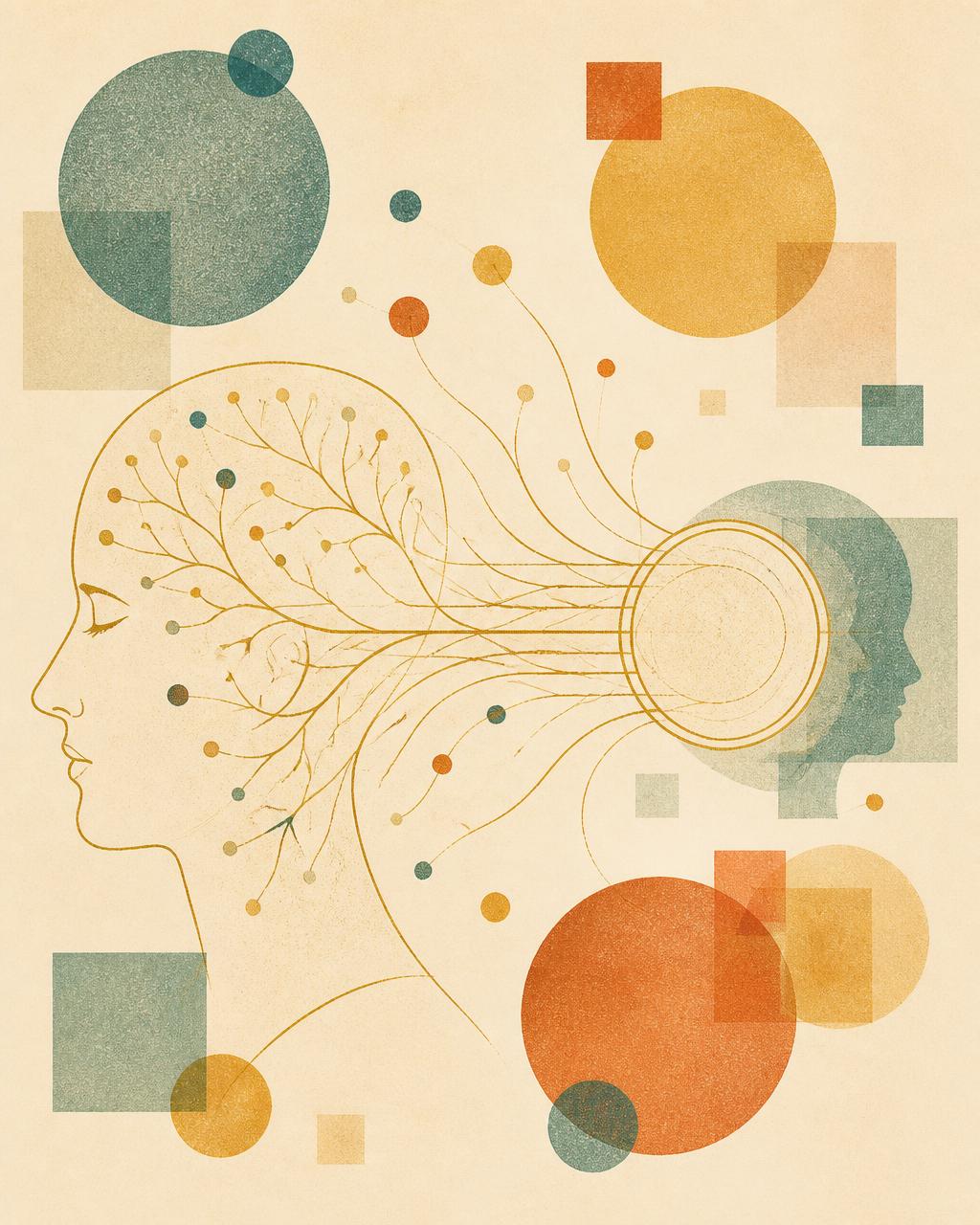
I still believe that explanation, but after another year of using AI extensively, I don't think it goes nearly far enough. What I've started to understand is that AI works unusually well for me because I've always been what I used to call an external processor. I often don't figure out what I think and then explain it. I explain, react, revise, argue, remember, connect, and somewhere inside that process, I discover what I think.
AI didn't create that process. It gave the process a new kind of surface to happen on.
I've Always Thought Outside My Head
Some people seem able to retreat into their own minds, work through an idea internally, organize it, and then present the finished thought to someone else. That has never particularly been how I work.
I frequently need something outside myself to push against. Conversation does that. Writing can do it. Someone asks a question, and I discover that I don't quite agree with the premise. I explain why, and halfway through the explanation I realize there's another piece I hadn't considered. That reminds me of something that happened fifteen years ago, which changes how I understand the original question, and now we're somewhere considerably more interesting than where we started.
For years, other humans were often part of that process, and they still are. There is tremendous value in talking something through with someone who knows me, challenges me, has their own experiences, and can introduce perspectives that aren't mine. But another human being is not a cognitive appliance, nor should they be. They have their own energy, interests, needs, limits, emotions, schedules, and attention spans.
If I want to spend two hours pulling apart the implications of a tiny distinction I just noticed, a friend may reasonably reach a point where they would like to eat dinner. If I circle back to something for the sixth time because I've realized that the wording still isn't quite right, a coworker may understandably wonder whether we're ever going to finish. If I dump thirty loosely related thoughts into a conversation, I also have to consider whether the other person has the bandwidth to receive them.
That's not a flaw in human collaboration. It's part of being in a reciprocal relationship with another person. But it does mean that the thing helping me think comes bundled with another thing my brain has to think about, and AI separates those functions in a way I had never experienced before.
A Thinking Surface That Talks Back
Researchers use the term cognitive offloading to describe the ways humans put some cognitive demands into the environment rather than carrying them entirely inside the brain. Writing something down so you don't have to remember it, setting an alarm, using a calendar, arranging physical objects as reminders, or relying on digital tools can all change the cognitive work required to complete a task.
We even use other people this way. Human beings have always distributed thinking across conversations, communities, written records, institutions, and tools. That helps explain part of my experience with AI, but I don't think offloading fully captures it.
When I use a calendar, the calendar doesn't react to what I wrote and say, "This sounds similar to another concept you may want to investigate." A notebook doesn't notice that two stories I told three pages apart appear to share the same underlying pattern. A search engine can help me find information if I already know what I'm looking for, but it doesn't always help me recognize that the thing I'm trying to describe has a name I didn't know existed.
AI can do something closer to dialogue. I can put an unfinished thought outside myself and get something back. That response might extend the idea, introduce a concept I haven't encountered, remind me of something, or be subtly wrong in a way that makes my brain immediately go, "No, that's not it at all," and force me to articulate why.
That last one is more useful than it sounds. Sometimes I don't know what I mean until something shows me what I don't mean.
Apparently My Brain Likes Something to Argue With
I've seen this repeatedly while developing essays for this site. I'll start with an old article, a sentence, or sometimes nothing more developed than "I think there's something here." AI gives me an interpretation, I react to it, and my reaction surfaces an anecdote. The anecdote introduces a contradiction. We follow that contradiction until I realize the article I thought I was writing isn't actually the interesting article at all.
Sometimes I answer a question immediately. Other times, when I'm asked something broad like, "Can you think of an example of this?", my mind produces absolutely nothing. Then I get several specific examples, one catches, and suddenly I'm saying, "OH. I have one," followed by a detailed story that I apparently had access to the entire time but couldn't retrieve through the original question.
The memory wasn't missing. The retrieval cue was wrong.
That means part of what AI is doing for me isn't supplying thoughts. It's helping create conditions in which my own thoughts become accessible. Once they're accessible, I can react to them, connect them to something else, question them, or realize that I've been carrying around a conclusion I no longer believe.
Then We Reach the Boring Middle
This is where ADHD becomes especially important to my experience.
I have no shortage of ideas. This has never been my problem. I can become intensely interested in something and stay there for an absurd amount of time. I can research a topic far beyond the point where most people would have decided they'd learned enough. I can make associations quickly, notice patterns, chase implications, and happily spend hours trying to understand why something works the way it does.
The problem arrives when the interesting part ends but the project doesn't.
Eventually I have to organize everything I learned, find the citation I vaguely remember seeing, compare sources, decide what belongs and what doesn't, figure out what I'm missing, put six nonlinear thoughts into an order another person can follow, return to the boring source because I need one specific detail from page 38, remember what the original point was after I've opened fourteen other tabs, finish the transition, clean up the structure, and do all the administrative shit surrounding the interesting thing.
This is where an enormous number of my ideas have historically gone to die. Not because they weren't good enough, because I stopped caring, or because I lacked the intellectual ability to finish them. The executive-function demands required to carry the idea through the uninteresting intermediate stages became greater than what my brain was reliably willing or able to provide.
Sometimes that's inconvenient. Sometimes it feels nigh unto impossible.
"AI Makes Things Easier" Is True and Still Misses the Point
This is why I bristle a little when AI assistance gets reduced to convenience.
Yes, it makes things easier. So do my glasses. So does magnification on my computer. So does the screen extender that gives me enough display space to work comfortably with that magnification turned on.
"Easier" doesn't tell you very much about what role a tool is actually playing.
For one person, reducing ten cognitive steps to three may mean they finish something faster. For me, there are situations where reducing ten steps to three can mean the difference between an idea becoming a finished thing and that idea joining the enormous graveyard of projects I was fascinated by but never managed to carry all the way across the gap.
That's not merely productivity. It's closer to lowering the activation energy required to convert thought into output.
AI can sometimes keep the scaffolding moving while I'm still allowed to stay close to the part my brain finds engaging. If I know there's a concept related to something I'm describing but can't remember the terminology, it can surface possibilities for me to investigate. If I have six ideas but can't see their structure anymore, it can reflect the pattern back to me. If I need research, it can help me locate the relevant body of literature instead of requiring me to spend the first hour figuring out what terminology researchers in that field use.
I still have to decide whether any of it is right, but I don't have to personally execute every intermediate cognitive operation required to keep the idea alive.
The Difference Between Offloading and Abdicating
This is also where the ethics of AI-assisted thought become much more complicated than either side of the argument often wants them to be.
There is plenty of AI slop in the world. I know exactly what it looks like because I spend an unreasonable amount of time removing it.
Ask an AI to "write an inspirational article about neurodiversity," accept the first output, and there's a decent chance you'll get an onslaught of tiny rhetorical paragraphs, neat little binaries, predictable metaphors, excessive section headings, generic encouragement, and some version of "your difference is your superpower."
I hate that shit.
The fact that a tool can produce mediocre content with very little human involvement is not evidence that every use of the tool contains very little human involvement. It means generative AI has made low-effort output astonishingly cheap to produce. Those are different claims.
What matters to me is not simply how much AI was used, but what cognitive work was delegated to it. There is a meaningful difference between asking for help surfacing research terminology, testing an argument, reorganizing material you've already developed, or generating something to react against and handing over comprehension, interpretation, judgment, and authorship because you never intended to do those parts yourself.
That's the difference between offloading and abdicating.
Good AI Output Requires Me to Know What "Good" Means
I've been using generative AI extensively for more than two years now, and I am dramatically better at it than I was when I started. That isn't because I've discovered a collection of magical prompts.
I've gotten better at articulating how I know when something is wrong.
That's a surprisingly difficult skill.
I can tell AI that I don't like a draft, but that's not nearly as useful as being able to say that the article keeps breaking related ideas into isolated one-line paragraphs and the rhythm sounds like generic LinkedIn thought leadership instead of the way I naturally develop an argument. I can say that an interpretation is too neat, that it's assigning more certainty to my experience than I actually have, or that it has converted a complicated trait into a redemptive "strength" narrative I explicitly reject.
Those judgments were once largely intuitive. Using AI has forced me to make them legible.
I've had to become more conscious of my own voice, thought patterns, ethical boundaries, assumptions, preferences, and standards for evidence because I have to communicate those things explicitly enough for the tool to work within them. Ironically, using AI has made me think more carefully about authorship rather than less.
If I can't tell the difference between mediocre prose and good prose, AI doesn't magically make me a good writer. If I can't recognize that a research claim sounds suspicious, fluent language can make misinformation more dangerous rather than less. If I don't know what I believe, I can very easily let a machine's beautifully organized answer masquerade as my opinion.
The better these systems become at sounding authoritative, the more important human judgment becomes.
My Daughter and I Disagree About This
My daughter finds generative AI deeply unethical, and we have an ongoing disagreement about my use of it. I understand where much of her discomfort comes from because I have serious ethical concerns too. There are unresolved questions about training data and creator consent, environmental costs, labor displacement, misinformation, educational use, and what happens when organizations adopt technology faster than law, culture, or ethical frameworks can respond to it.
I don't think enthusiasm for what AI does for me requires pretending those problems don't exist.
Where my daughter and I diverge is in how quickly the use of AI can become evidence that the finished work required less thought or deserves less respect. To her, AI's involvement can make the artifact itself feel intrinsically suspect. From inside the process, my experience is very different.
These essays don't emerge because I type a sentence asking for an article and then wander off while a machine produces my thoughts. The process often contains hours of conversation, disagreement, memory retrieval, research, correction, structural decisions, discarded interpretations, and repeated editorial passes. Sometimes the most important thing AI contributes is an idea I reject, because explaining why I reject it forces me to formulate the thing I actually believe.
The labor hasn't disappeared. It has moved.
Maybe Authorship Is Moving, Too
Generative AI makes us uncomfortable partly because it can imitate the artifact we've historically used as evidence that thinking occurred. A finished essay looks like thinking, but now a machine can generate a finished-looking essay without the person requesting it having done much thinking at all.
That's a real problem. It also exposes something that may always have been true: the artifact was never the thought itself.
For me, authorship increasingly lives in a combination of lived experience, inquiry, judgment, direction, interpretation, verification, rejection, synthesis, and final editorial authority. That doesn't mean wording is irrelevant or that every person directing AI is meaningfully the author of whatever it produces. There is obviously a continuum between writing something yourself, heavily collaborating with a tool, and pressing a button and claiming whatever comes out.
I don't think we have particularly good cultural language for that continuum yet. What I do know is that "AI touched this, therefore the human didn't do the work" doesn't describe what I've experienced.
Sometimes the work AI removes is precisely the work that was preventing my other work from becoming visible.
The Thing Human Collaboration Can't Give Me
There is another reason AI works so well for my particular form of external processing, and it isn't something I think a human collaborator should be expected to replicate.
AI can function like an external mirror with access to a breadth of information no individual human being could possibly hold. That doesn't mean it possesses the whole of human knowledge or that what it tells me is always correct. It absolutely does not. When accuracy matters, I still need sources, verification, and enough skepticism to recognize that fluent bullshit remains bullshit.
But it can dramatically reduce the time between "I think there's a concept here" and "here are three bodies of research that might help us understand it."
Historically, I could reach the same place through research, and I love research. Unfortunately, research introduces its own cognitive overhead. I need to figure out what I'm looking for, find the vocabulary experts use for it, locate credible sources, read them, hold enough information in working memory to compare them, remember how they connect to the original thought, and somehow avoid becoming fascinated by seventeen adjacent questions before I return to the one I started with.
AI can compress parts of that process while I'm still actively thinking about the original idea. That matters because my interest is not an unlimited resource I can simply pause and resume at will. Sometimes the cognitive scaffolding has to arrive while the thought is still hot enough for me to follow it.
I Don't Want AI to Think Instead of Me
Cognitive offloading has tradeoffs. External tools can improve immediate performance while also changing what we retain, practice, or learn internally. AI makes that tension more significant because the tool can now participate in cognitive work that used to require much more direct human effort.
I think those concerns are legitimate, and there are things I don't want AI to do for me. I don't want it to decide what I believe. I don't want it to replace the discomfort of wrestling with an ethical question. I don't want it to generate a confident interpretation of my life and have me accept it simply because the sentences are persuasive. I don't want to lose my ability to write without it, evaluate evidence without it, or recognize when something doesn't make sense.
What I want is scaffolding. I want the scaffolding to hold the pieces while I climb around and decide what I'm building.
That distinction won't always be obvious from the finished artifact, which is one reason conversations about AI authorship get complicated so quickly. Two people can submit similarly polished work after using the same class of tool while having delegated radically different amounts and kinds of thinking to it.
Human Relationships Were Never Supposed to Be Cognitive Infrastructure
There's something slightly uncomfortable about saying that part of what makes AI wonderful for me is that it doesn't have emotional needs. It can sound selfish if you strip away the context, because human relationships should involve reciprocity. Other people aren't supposed to exist solely as processing surfaces for us.
A friend is entitled to boundaries. A coworker is entitled to fatigue. My husband is allowed to be bored by a tangent. Another writer is allowed to have feelings when I radically rewrite something they created. Human collaboration involves reciprocity because other people are full human beings rather than services my brain consumes.
AI gives me something different: much of the cognitive usefulness of dialogue without requiring another person to absorb the interpersonal cost of being my processing environment.
I don't have to ask whether it has the emotional bandwidth for another iteration. I don't owe it equal processing time tomorrow. I don't have to stop following an idea because I realize I've monopolized the conversation for forty minutes. I can provide far too much context, change direction, contradict something I said twenty minutes ago, and keep pulling at the thread until I know why it caught my attention in the first place.
Removing those considerations doesn't mean human collaboration is defective. It means perhaps I've spent much of my life asking human relationships to perform a cognitive function they were never perfectly designed to perform.
Maybe This Is What Accommodation Can Look Like
I hesitate to call generative AI an accessibility tool in any universal sense. Neurodivergent people are not a monolith, AI can create new accessibility problems of its own, and a tool that functions as cognitive scaffolding for me could function as distraction, substitution, or something actively unpleasant for someone else.
But I do think my use of it has an accommodation-like effect because it lowers the executive-function cost of turning an idea into something I can use. It lets me externalize thoughts without immediately organizing them, holds context while I follow one branch, generates retrieval cues, gives me something responsive to push against, surfaces domains of knowledge I might not have known to investigate, and helps carry some of the boring connective tissue that used to be the point where my interest collapsed and an idea disappeared.
Humans in general use external tools to extend cognition. That isn't uniquely ADHD, and I don't want to pretend it is. ADHD adds a particular layer to my experience because executive-function barriers can make the distance between idea and execution unusually consequential.
For someone else, AI may primarily save time.
For me, sometimes it saves the thought.
The Thought Didn't Exist Yet
That's the part I couldn't articulate when I wrote the LinkedIn article in 2025. I said AI gave me room to bring my full mind to the table without editing myself down to fit, and I still believe that.
What I understand now is that sometimes I don't bring the finished thought to the table at all. I bring a fragment, an irritation, a story, a contradiction, something I read that won't leave me alone, a sentence that feels almost right, or an intuition that there's a connection I can't see yet. Then I put it outside myself, something comes back, I push against it, and another thought appears.
The interaction continues until eventually I recognize the shape of something that didn't exist in finished form when I started.
That's what an external processor has always needed: not someone to hand me the answer, but somewhere for the thinking to happen where I don't have to hold every moving part at once.
For the first time, I have a responsive external thinking environment that can keep up with the associative jumps, help me across some of the executive-function gaps, and introduce information from far beyond what I could personally keep available in my head.
AI isn't doing my thinking for me. It's giving more of my thinking a chance to become something.
And given how many ideas I've lost between "this is fascinating" and "I finished it," that distinction feels enormous.
Extended Reading
Tabby Worthington — "Why AI Collaboration Feels So Natural to My Neurodivergent Brain"
The November 17, 2025 edition of my LinkedIn newsletter Non-Standard Human that prompted this deeper exploration. The original article focused primarily on reduced masking and social overhead during AI collaboration; this essay expands the idea into external processing, cognitive offloading, executive function, authorship, and the difference between scaffolding thought and replacing it.
Risko & Gilbert — "Cognitive Offloading"
A foundational review defining cognitive offloading and examining how people use external actions and tools to reduce internal cognitive demands.
Read more →Armitage & Redshaw — "Can you help me? Using others to offload cognition"
Research examining the use of other people as cognitive resources, useful for understanding why external processing through dialogue is not unique to AI.
Read more →Gilbert et al. — Research on intention offloading
Research examining how people use external reminders and environmental cues to support prospective memory and reduce internal cognitive demands.
Read more →Research on executive function in ADHD
A review examining executive-function difficulties in ADHD and approaches intended to support them.
Read more →"The Experience of Effort in ADHD: A Scoping Review"
Research particularly relevant to the distinction between wanting to accomplish something and being able to initiate and sustain the effort required to move toward it.
Read more →Research on distributed cognition and technology
Background on cognitive offloading and distributed cognition, including the benefits and potential costs of relying on increasingly capable external cognitive tools.
Read more →