Essay · 16 minute read
The 70% Problem
Capacity, task trees, and why "almost done" is not a measurement of what's left.
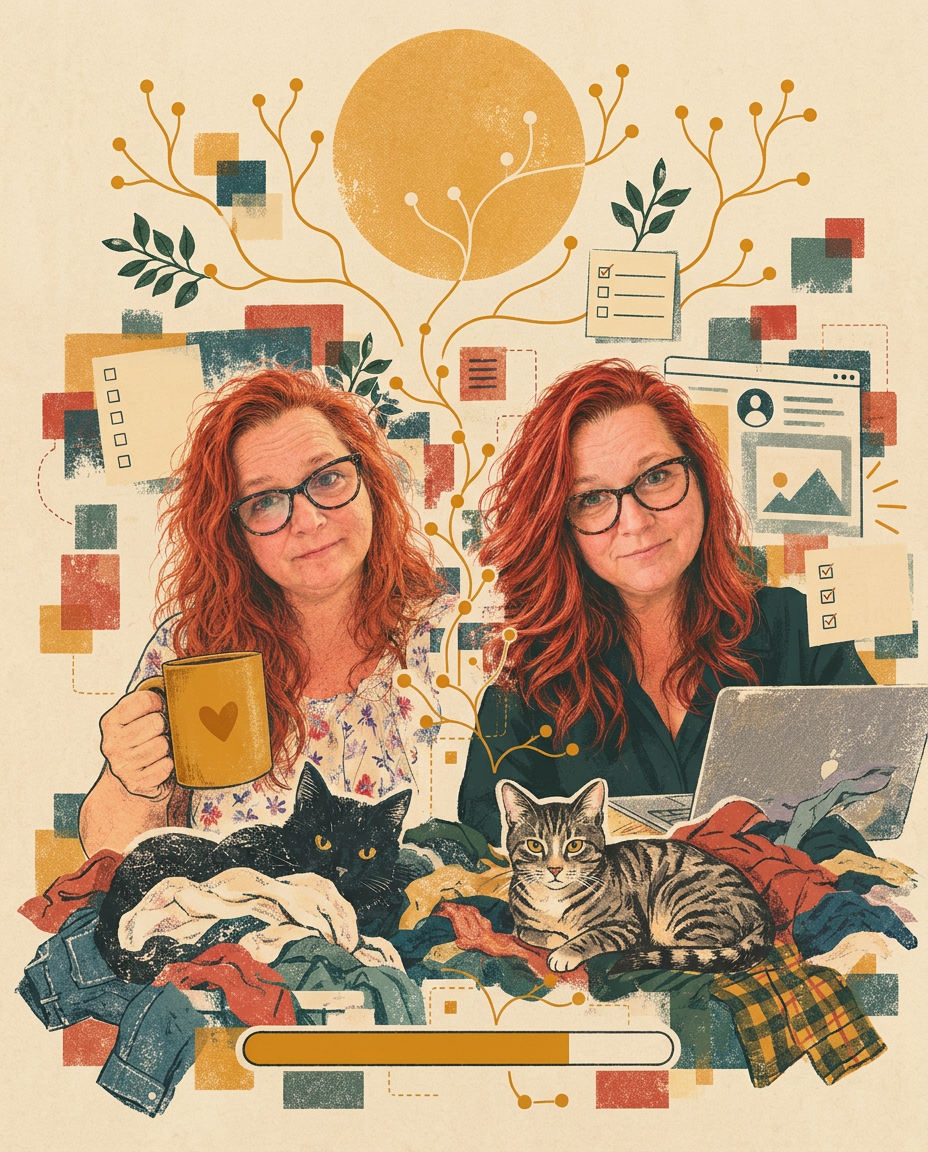
I changed my Facebook profile picture recently to an AI-generated portrait of myself. It was pretty good, but it wasn't quite me. The red hair was right. The glasses were right-ish. The face was close enough that nobody was going to wonder whose profile they had landed on, but anyone who actually knows me could probably find the places where the machine lost the thread. I had even explicitly told it to preserve my laugh lines and the other signs of aging I have earned as a nearly 50-year-old woman. I didn't ask it to make me younger. I didn't ask it to make me prettier. I asked it to make me look professional. The Result: Close, but no cigar.
A couple of people commented with some variation of, "You're prettier than AI," or "You're smarter than AI." They meant it kindly, at least on the surface. I knew what they were trying to communicate, and under other circumstances I might have appreciated the sentiment. Instead, I hid the comments, because they made me uncomfortable in a way I couldn't immediately articulate.
I think part of the problem was that they were answering a question I never asked. I wasn't trying to find out whether AI could make a better version of me. I wasn't competing with the machine for the title of Smartest or Prettiest Tabby. But there was something else underneath some of those comments, too, something that wasn't really about whether I was prettier or smarter than the computer at all.
It was judgment about the fact that I had used the tool.
That is a much more complicated thing to talk about, because I have complicated feelings about it too. But before I can explain why I used AI to make a fake picture of my own face, I have to tell you about my bathtub.
My Bathtub Is Full of Dirty Laundry
I am struggling with hoarding right now. Not in the quirky "I have too many craft supplies" way people sometimes use the word. I mean really, really struggling. I got back into therapy recently, and my new therapist has helped me identify something that seems obvious now that she has said it out loud: one of my biggest problems is capacity.
It is bad enough right now that I don't shower very often. Maybe once a week. I'm not depressed. I don't have an aversion to being clean. I know I need to shower, I want to have showered, and I am fully capable of performing every physical action involved in taking a shower. None of those things mean I actually have the capacity to do it.
Because I can't just take a shower. My bathtub is currently full of bags of dirty laundry, so first those have to move. Moving them doesn't solve the problem, of course, because now I have bags of dirty laundry somewhere else, and eventually those clothes need to be washed, dried, folded or hung up, and put somewhere. The bathroom floor also needs to be swept because I live with a small army of cats who consider litter tracking a competitive sport. Technically I can shower without sweeping, but then I step out clean and immediately have cat litter stuck to my wet feet, which makes the entire exercise feel vaguely pointless.
"Take a shower" is therefore not one task. It is a task tree: move the laundry, decide where it goes, deal with at least some of it, clear the bathroom, sweep the floor, find clean clothes, find a towel, shower, deal with everything afterward. Every branch creates more decisions, and every decision consumes a little more of a resource I am already rationing.
This is one of the problems with talking about capacity from the outside. Someone looking at the final action sees a shower. They know a shower takes ten minutes, so the obvious conclusion is that I must not want to spend ten minutes taking one. What they cannot see is everything my brain has attached to those ten minutes before I ever turn on the water.
There is research describing experiences remarkably similar to this. Researchers studying autistic inertia have documented autistic adults struggling to start, stop, or switch activities even when they genuinely wanted and intended to do them. Participants described decisions, interruptions, physical obstacles, and prerequisite tasks increasing the difficulty of taking action. In one qualitative study, a participant described wanting to sweep a floor, only to encounter objects that had to be moved first. Moving those objects required decisions about where they belonged, which generated additional tasks until the apparently simple job had become an exhausting network of problems.
When I encountered that example, my immediate reaction was essentially, Oh, cool. They found my bathtub.
Wanting and Doing Are Not the Same Thing
There is an assumption buried in a lot of the language we use about productivity: if you genuinely want an outcome badly enough, you will make yourself do the things required to achieve it. When someone repeatedly fails to do that, we tend to reach for moral explanations. Lazy. Undisciplined. Unmotivated. Irresponsible. Not trying hard enough. Not living up to your potential. You could do it if you really wanted to.
Neurodivergent people hear versions of those judgments a lot, and they can be devastating because they turn a problem of execution into a problem of character. Research into ADHD offers a useful distinction between motivation and volition. Motivation concerns the desire or willingness to pursue something; volition concerns translating intentions into goal-directed action and sustaining that action. The research into mental effort and ADHD is still developing, and I don't want to turn an emerging body of evidence into a sweeping neurological explanation for every unfinished project, but the distinction describes something I have experienced my entire life: I can desperately want the result and still struggle to execute the process required to produce it.
That distinction changes the question. If failure to act proves failure to care, then the solution is always some version of "try harder." If desire and execution can come apart, though, trying harder may not address the thing that is actually preventing action. Sometimes the useful intervention is reducing the number of decisions, transitions, prerequisites, or other demands standing between intention and execution.
This is where I keep running into what I have started thinking of as the 70% problem.
The 70% Problem
To be clear, "the 70% problem" is my term, not a clinical phenomenon. There is no diagnostic manual declaring that neurodivergent people complete exactly seven-tenths of every project before wandering off in search of a more interesting dopamine source. It's just the name I have given to a pattern I recognize in myself, and one I hear echoed often enough by other neurodivergent people that I know I am not alone in it.
I can get something 70% done. Sometimes 80%. Sometimes 95%. I can do the difficult, creative, complicated part of the work, and then suddenly the capacity that carried me through it evaporates in a cloud of frustration and despair. What remains might look laughably easy compared with everything I have already accomplished, which makes being unable to finish it all the more frustrating.
From the outside, the response seems obvious: But you're almost done. Just finish it. The problem is that "almost done" is a measurement of output. It is not a measurement of remaining capacity.
Seventy percent of the visible task does not necessarily represent 70% of the cognitive work. The last 30% might contain most of the decisions. It might require switching contexts, resolving loose ends, cleaning things up, naming files, putting things away, sending emails, making appointments, asking someone for something, choosing between imperfect options, or deciding what happens to the thing once it stops being a work in progress. Sometimes finishing Task A also reveals Tasks B through Q, which were politely waiting behind it the whole time.
That means the progress bar and my brain can be reporting completely different things. The progress bar says I have only 30% left. My brain is looking at what that 30% actually contains and saying, Absolutely the fuck not.
If you have spent enough of your life being told that you are intelligent and capable but inexplicably fail to follow through, unfinished things also begin to acquire moral weight. They stop being neutral evidence of limited capacity and start feeling like evidence in a prosecution. The laundry is no longer laundry. The unfinished project is no longer a project. The email you have been meaning to send for three weeks is no longer an email. They all start saying the same thing: See? You did it again.
Now finishing the task requires confronting not only whatever executive demands remain, but also the accumulated shame of all the other times you have found yourself here. Sometimes I think that is why an objectively tiny final step can feel so disproportionately enormous. It is carrying baggage from every other finish line I didn't cross.
Sometimes the Problem Is What Comes After 100%
There is another version of the 70% problem that makes even less sense from the outside. There are video games I have played almost all the way through and never finished. I didn't get bored with them. The final boss wasn't too difficult. I didn't forget they existed. I loved them, and I didn't want them to be over.
As long as I don't finish the game, there is still something left for me inside it. There is still somewhere to go, something to discover, some final encounter waiting for me. Crossing the finish line changes my relationship to something I have loved. It becomes a thing I finished, and suddenly I have to answer a question I have been able to postpone: What now?
I have started noticing that question hiding behind other unfinished things, too. What happens after I publish this? What happens after someone sees it? What happens if it succeeds? What happens if it fails? What happens when the enormous project that has occupied my brain for months is suddenly gone? What do I have to do next? The unknown on the other side of the finish line is itself a demand, and sometimes I do not have capacity for that demand yet.
That can absolutely turn into self-sabotage. Avoiding a transition today can create a much larger problem for Future Tabby, who has inherited a truly unreasonable number of consequences from Present and Past Tabby and would probably like to unionize. Understanding why I do something does not magically erase its consequences, but it does let me ask a better question than Why the hell can't I just finish this?
What is the finish line asking of me that I cannot see?
Behavior that looks irrational can become surprisingly coherent once I identify the invisible demand behind it. That doesn't make the behavior harmless, and it doesn't mean I should never push through discomfort. It means I have something more useful to work with than shame.
Which Brings Me Back to the Fake Picture of My Face
I needed to update my personal website. This matters more than I would like it to because the job market scares the shit out of me right now. I live with the background fear that I could lose my job and find myself competing in an employment landscape that is changing faster than I can comfortably keep up with. I have already changed careers multiple times in my life. I don't want to reinvent myself again. I want to keep doing the kind of work I am good at until I am ready to retire.
So I am learning the tools that are becoming part of that work, including AI tools. I am learning an AI design platform we're using as we prepare to build a new website at work. I am working on growing the social audience for my cat rescue because I would eventually love for the content I already create to generate meaningful income. I am trying to build options because options feel a lot like safety when the future is uncertain.
And I needed my personal website to stop sitting at 70%.
One of the stupid little blockers was a photograph. I did not have a good current professional photo, and I did not have a good place in my house to take one. Hiring a photographer costs money, and I don't know if everyone has noticed, but THE ECONOMY FUCKING BLOWS and "professional headshots" is not currently high on my list of places I would like to put extra money.
Doing it myself was theoretically possible. That would mean finding an appropriate place, figuring out lighting, making myself presentable, setting everything up, taking a million pictures, deciding which one I hate least, editing it, and finally putting it on the website. There was my task tree again, sprouting branches between me and something that should have been simple.
Or I could give an AI tool some photographs of myself and ask it to make something serviceable.
So I did.
The tool did not create a better me. It did not create a smarter me or a prettier me. It created an image that was close enough for the purpose I needed it to serve, and more importantly, it removed a blocker.
There Is an Ethical Question Here. Actually, There Are About Fifty.
This is where I have to return to those Facebook comments, because I don't think all of them were really trying to reassure me that the actual human version of me is superior to an algorithmic approximation. There was another message underneath some of them, whether the people leaving those comments consciously intended it or not: You shouldn't need this. You shouldn't be using this.
Here's the uncomfortable part: I don't entirely disagree with the concern behind that judgment.
The ethics surrounding generative AI are a fucking mess. There are legitimate questions about how training data was obtained and whose creative work contributed to enormously valuable commercial products. There are serious questions about what happens to artists, writers, designers, and other workers whose livelihoods are affected; about energy and water consumption; about misinformation; about bias; about ownership; and about what happens when corporations discover that a technology capable of increasing human capacity can also be used as an excuse to employ fewer humans.
The problems are everywhere. I see them. I care about them. I am not asking anyone to pretend they don't exist so I can feel better about generating a profile picture.
But I have had to separate two questions that are very easy to collapse into one: What do I believe is wrong, and what action available to me has a meaningful chance of changing it?
Sometimes refusing to buy or use something is exactly the right answer. Boycotts and consumer pressure can be useful when enough people participate, when the target depends on their participation, and when there are meaningful alternatives. There are products I will not buy from companies whose behavior I do not want to support, especially when I can walk across the proverbial street and buy essentially the same thing from somebody else.
This is not quite that.
There is a difference between sacrifice and impact, and I think we sometimes confuse the two. I can make an enormous personal sacrifice without meaningfully affecting the system I am protesting. The fact that the sacrifice hurts me does not make it more effective, and suffering is not evidence that a strategy is working.
If my house is a disaster and I have enough capacity to clean one thing, I can spend an hour meticulously cleaning one pane of glass on the back door. At the end of that hour, I can truthfully say that I cleaned. That glass may fucking sparkle. But if my actual goal was to make the house more functional, the relevant question is not whether my action technically qualified as cleaning. It is whether I spent my limited capacity somewhere that materially changed the situation.
The house is still a disaster.
That is increasingly how I feel about refusing to learn or use AI as an individual moral protest. The machine driving AI adoption is considerably larger than my participation in it. Companies are integrating AI into software people already use. Employers are incorporating it into workflows and job expectations. Entire professions are figuring out which parts of their work can be accelerated, augmented, automated, or eliminated by it. My refusal to participate does not make those forces disappear.
It does, however, change something much closer to home: which jobs I am qualified to do.
I work in digital marketing, and the work I do is increasingly intertwined with AI. I am currently learning an AI design tool because it is part of how we are building our next website. Being able to work effectively with these systems is becoming part of the skill set expected of people who do what I do. I do not have to be delighted about every aspect of that reality to recognize that pretending it is not happening would be a spectacularly bad career strategy.
If I refuse to learn those skills on moral grounds, AI adoption does not stop. Employers do not collectively reconsider their technology strategies because I have removed myself from consideration. The job market does not politely preserve a collection of equivalent positions for conscientious objectors. I simply put myself in competition for the shrinking subset of jobs that do not expect me to know how to use the technology.
That may be a sacrifice, but I don't think it is an effective protest.
And this isn't just refusing to buy delicious chicken from a hateful man. I can get chicken somewhere else. I cannot take my digital marketing career across the street to the alternate economy where generative AI never happened. I have to make decisions inside the economy that actually exists.
Those decisions do not affect only me, either. I have a family. I have a mortgage. I have animals who depend on me. I enjoy food and remain deeply committed to air conditioning. I have already changed careers more than once, and I don't want to do it again. I want to remain employable in the field where I have spent years building skills and experience until I am ready to retire.
There are places where ethical pressure on AI may accomplish far more than my personal abstention ever could. Regulation matters. Labor protections matter. Copyright and compensation models matter. Transparency matters. Environmental standards matter. Collective action matters. The rules companies operate under and the incentives that shape their behavior matter. We should absolutely be arguing about all of those things.
But deliberately making myself less employable does not strike me as meaningful pressure on the AI industry. It strikes me as deliberately making myself less employable.
When capacity is already a scarce resource, I have to care not only about whether an action expresses my values, but whether it has a reasonable chance of advancing them. I don't have enough capacity to confuse personal sacrifice with meaningful action.
Sometimes AI Gives Me Capacity
This is the other reason I use AI that is difficult to explain unless you understand the 70% problem. AI is not merely a professional skill I feel compelled to learn because the job market is changing. Sometimes it genuinely makes parts of my life more accessible to me.
It cannot add hours to my day or executive function to my brain. It cannot empty my bathtub, wash the laundry, sweep the litter off the bathroom floor, or take the shower for me. What it can sometimes do is prune the task tree.
It can eliminate three decisions. It can get me past a blank page. It can organize the pile of information I have already collected. It can turn the amorphous thing in my head into a structure I can react to instead of requiring me to create that structure from nothing. It can help me identify the next step when the entire project has become an undifferentiated wall of too much. It can make the serviceable headshot that removes the blocker preventing me from finishing the website.
It can reduce the activation cost of getting something done.
For someone with abundant capacity, that may look like convenience. For someone who is constantly triaging limited capacity, the difference between six steps and three can sometimes be the difference between done and not done at all. That distinction matters to me far more than whether the resulting process satisfies somebody else's idea of how much work I should have been willing to do myself.
None of this makes every use of AI good. It does not absolve the companies building it of responsibility. It does not mean artists should stop worrying about what it means for their livelihoods, or workers should enthusiastically accept whatever version of automation their employers decide to impose on them. It does not require me to choose between "AI is good" and "AI is bad," because almost nothing this large and consequential is usefully described in terms that simple.
It just means that for me, the relevant comparison is sometimes not human versus AI.
It is me with the tool versus me without enough capacity to finish the thing.
The Comments Were Answering the Wrong Question
That is why those Facebook comments bothered me. "You're prettier than AI" and "You're smarter than AI" sound supportive if the question is whether the machine can replace the human being. They sound different when the machine was never competing with the human being in the first place.
Of course I am more me than an algorithmic approximation of me. The actual human being is going to contain more humanity than the synthetic portrait. That isn't much of a contest. The AI portrait didn't beat me at being me, and I didn't lose anything when it generated a face that looked approximately like mine.
What I had was a problem. I had limited money, limited capacity, a website I needed to finish, a career I need to protect, and one stupid dependency standing between me and getting something done. I used a tool to remove that dependency. The result was imperfect, and I knew it was imperfect when I posted it.
It didn't need to be perfect. It needed to get me across the finish line.
When you live your life repeatedly getting stranded at 70%, done is an extraordinary thing.
Extended Reading
"No Way Out Except From External Intervention": First-Hand Accounts of Autistic Inertia
Karen Leneh Buckle, Kathy Leadbitter, Ellen Poliakoff, and Emma Gowen
A qualitative study of autistic adults' first-hand accounts of inertia: difficulty starting, stopping, and switching activities even when they wanted and intended to act, and how prerequisite tasks multiply before a simple action.
Read more →'I Live in Extremes': A Qualitative Investigation of Autistic Adults' Experiences of Inertial Rest and Motion
Hannah Rapaport, Hayley Clapham, Jon Adams, Wenn B. Lawson, Kaśka Porayska-Pomsta, and Elizabeth Pellicano
Interview-based research on inertial rest and motion in autistic adults, examining both the disabling difficulty of initiating tasks and the difficulty of stopping them.
Read more →The Experience of Effort in ADHD: A Scoping Review
Danika Wagner, Samantha G. Mason, and John D. Eastwood
A scoping review of how people with ADHD experience mental effort, including the gaps and inconsistencies in a research area still taking shape.
Read more →Effort Allocation in Children With ADHD: Abnormal Decision-Making or Poor Execution?
Yael Winter, Hilla Ben-Pazi, and Yehuda Pollak
Research distinguishing the decision to choose effort from the ability to execute it, in children with ADHD — the wanting/doing split described above.
Read more →